Showing posts with label graffiti. Show all posts

Wednesday, December 9, 2009

Activism Through Graffiti in Tel Aviv

Photo collection of social activism through street art in Florentine, Tel Aviv:


Translates to “No Children, No Terror Attacks”

Wednesday, December 2, 2009

“STREET ART and SOCIAL MOVEMENTS”

Throughout history, street art has been used as a form of social commentary for those have no input or control of the media. It is an illegal, primal way of communicating social concerns or revealing one’s point to a large audience.

PARIS, 1968…

With the student and worker’s revolt of May and June of that year came a surge of street art, while France sat on the brink of a revolution. Protest wasn’t just the marches and picket signs. It was the representation of the plight faced by workers and students, fixed onto buildings throughout Paris by use of graffiti.


SOUTH AFRICA, 1970s-1980s…

With the swell of youth uprising against the apartheid in late 1970s South Africa came a revolution aided by street art. Though forbidden, anti-apartheid propaganda soared in popularity. People of South Africa joined together to visually present the oppressive world in which they live.

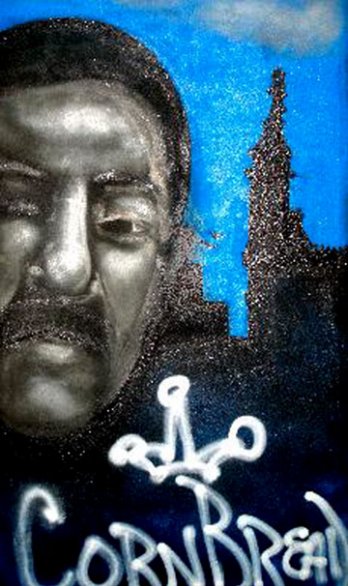
CORNBREAD

Darryl “Cornbread” McCray is a former Philadelphia graffiti artist who gained notoriety for spraying his logo across the city from the late 1960s to early 1970s. Now a mild-mannered arts advocate, McCray is appalled by the evolution of graffiti as an art to a form of vandalism. It was in the 1980s when McCray realized how spray paint and vandalism left Philadelphia a mess. McCray helped clean-up his city by becoming a member of Mayor Wilson Goode’s former Anti-Graffiti Network. Since this time, McCray has become an avid supporter of the Philadelphia Mural Arts Program, and works as a public speaker for this cause.

Jon E. Bekken, chairman of Albright College’s communications department realized McCray’s value as a knowledgeable expert in street art and invited the artist to speak at the school. “I’m interested in a wide range of communications, in particular in ways in which people who don’t have access to media outlets try to get a voice,” Bekken said. McCray gave some pointers to prospective taggers of the college: “If you’ve got the talent to do graffiti, you can get paid for it. But don’t go out and vandalize.”

BANKSY

As an oft controversial, bold, and somewhat anonymous artist, Robin Banks (better known as Banksy) is England’s premier graffiti artist. Banksy’s art is displayed with guerilla-like tactics, astonishing the unknowing public. He is also world-renowned for his “headline-making stunts” which include leaving an inflatable doll (which was dressed as a Guantanamo prisoner) at Disneyland in California. Always provocative, Banksy even has a few celebrity collectors, such as Brad Pitt and Angelina Jolie. The most prevalent theme in Banksy’s work is his attempts to provoke the audience to think abstractly and away from the norm.


SOURCE:

http://www.dailymail.co.uk/femail/article-1034538/Graffiti-artist-Banksy-unmasked---public-schoolboy-middle-class-suburbia.html

“Graffiti Art - A Solution to Urban Decay?”

Tan Rulxlang William, an art expert and writer for ezinearticles.com, argues the benefits of graffiti in an urban area. In his opinion, graffiti is often not meant as an act of vandalism by the artists, but “as a form of community beautification.” This form of art works as a stark contrast to the commercialism that plagues the public domain. As anyone can see it, graffiti is the ideal medium to connect with the general public.

SOURCE:

http://ezinearticles.com/?Graffiti-Art-A-Solution-to-Urban-Decay?&id=816264

Thursday, November 19, 2009

Grafitti artists against poverty

Montana shop and charity organization “Petits Riens/Spullenhulp” invited Blancbec, Hell’o Monsters, Pae 86, Bue, End, Nico, Whitecat and Polak to decorate those boxes where people can give clothes they are not wearing anymore. This “Peau Neuve / Nieuw Kleedje” campaign is intended to make people conscious of the fact that more and more young adults (18-24 years old) are homeless these days.

http://www.laid-back.be/blog/?p=272

Thursday, November 12, 2009

The Art of Street Art

How does graffiti and street art work? Well, it can be seen as a sort of “guerilla advertising” like practice. To the average person walking along the sidewalk, public art like this stands out, and can certainly leave an impression. Instead of publicizing something commercial, the artist promotes his or her own beliefs, or simply wants to show off their artwork. In Philadelphia, Street art is most often seen via “tagging” (graffiti featuring words or symbols as opposed to images) or through the Mural Arts Program.


Sources:
http://www.thefreedictionary.com/tagging
http://citynoise.org/article/9363/in/philadelphia@pa
http://www.flickr.com/photos/moocat/281385059/

An Introduction to Street Art

In a research endeavor, I originally attempted to find PROTEST ART local to Philadelphia. Unfortunately, this was too narrow a topic to find anything substantial or meaningful. I began to research a related topic: GRAFFITI ART of Philadelphia, and how it promotes change.


Source:
http://citynoise.org/article/9363/in/philadelphia@pa