Showing posts with label education. Show all posts

Wednesday, December 2, 2009

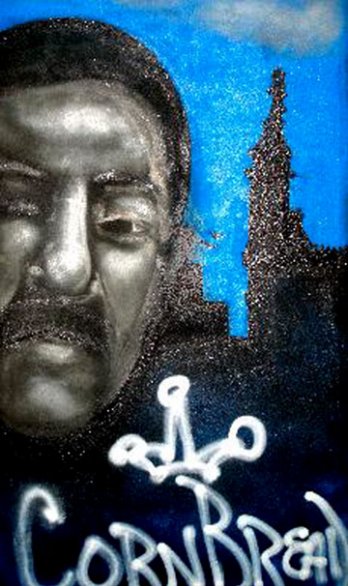
CORNBREAD

Darryl “Cornbread” McCray is a former Philadelphia graffiti artist who gained notoriety for spraying his logo across the city from the late 1960s to early 1970s. Now a mild-mannered arts advocate, McCray is appalled by the evolution of graffiti as an art to a form of vandalism. It was in the 1980s when McCray realized how spray paint and vandalism left Philadelphia a mess. McCray helped clean-up his city by becoming a member of Mayor Wilson Goode’s former Anti-Graffiti Network. Since this time, McCray has become an avid supporter of the Philadelphia Mural Arts Program, and works as a public speaker for this cause.

Jon E. Bekken, chairman of Albright College’s communications department realized McCray’s value as a knowledgeable expert in street art and invited the artist to speak at the school. “I’m interested in a wide range of communications, in particular in ways in which people who don’t have access to media outlets try to get a voice,” Bekken said. McCray gave some pointers to prospective taggers of the college: “If you’ve got the talent to do graffiti, you can get paid for it. But don’t go out and vandalize.”

Sunday, November 22, 2009

Here is a slide show put together of local art centers, and some quick information, but i suggest looking up these places for further research on getting involved locally in the arts.
Slide Show:
The Banana Factory
Luna Parc
Bottle Works Ethnics Art Center
Painted Bride Art Center
Brandywine Workshop
Additional art centers... Abington Art Center, Allens Lane Art center, Brewhouse space 101, Cheltenham Art center, The Clay studio, Trick Art and historical center, Mahayunk Art Center, Philly Art Alliance, Pittsburg Center for the Arts, Pittsburg Filmmakers, Pittsburg Glass Center, The Print Center.

Thursday, November 19, 2009

Where to Find Free Art Education Online

Art is an expression of thought, emotion and observation. Because art predates history, we have no concept of what our world would be like without it.


http://diplomaguide.com/articles/Where_to_Find_Free_Art_Education_Online.html

Wednesday, November 18, 2009

About the Fleisher Art Memorial

About the Fleisher Art Memorial

The Fleisher Art Memorial, founded by Samuel S. Fleisher as the Graphic Sketch Club in 1898, is now the nation's oldest tuition-free, community-based art school. From its inception, Fleisher's mission has been to guarantee access to professional arts instruction, especially for minority and low-income populations. Fleisher continues to be guided by the spirit of its founder, who believed that the arts were vital to the life of any community and wanted to reduce barriers, both real and presumptive, to participation in the arts.
In 1944, when Samuel Fleisher died, the Graphic Sketch Club lived on. The name of the Club was changed to the Samuel S. Fleisher Art Memorial, and the Philadelphia Museum of Art was charged with administration of the program, collections, and facilities of this independent 501(c)3 organization.
Today, Fleisher offers art classes and workshops for children and adults of all levels, exhibitions, and a variety of unique programs in partnership with the community.

Article from the Inquirer about Fleisher Art Memorial

Concerns over change in focus at Fleisher

The Fleisher Art Memorial, home of free and low-cost art classes for its South Philadelphia community for more than a century, has been buffeted by criticism in recent months as it modifies both programs and focus. Some students, primarily long-time devotees of Fleisher's offerings, are concerned that free classes are disappearing, fees are rising, and overall offerings are shrinking.
Change is in the air, they say, and they are unhappy with the portent, which could see the school refashioned from something unique into "a traditional art school," said Richard Lipartito, a former student.
"This isn't necessarily wrong, but it is not what it has traditionally been," he said, citing newly instituted limitations on class sizes, elimination of many free offerings, and imposition of stricter registration requirements that discourage student artists from roaming from class to class.
"You've lost freedom," Lipartito said.
Matthew Braun, who became head of the South Philadelphia school in early 2007, has scheduled what he called a town hall-style meeting at the school, 719 Catharine St., tonight from 5:30 to 7:30 to discuss the changes.
"We are trying to find a way to look at free open enrollment that is more sustainable for Fleisher," Braun said this week. As a result, he said, "We've pressed the temporary pause button to figure out" how to offer those types of programs more efficiently.
"This is not a permanent change. We need time to evaluate."
Fleisher began life in 1898 as the Graphic Sketch Club, started by woolen manufacturer Samuel S. Fleisher as a means to teach art to poor children who lived in the neighborhood of the Fleisher factory.
Since then, Fleisher has expanded its horizons and now annually teaches about 5,000 students of all ages. About 17,000 visitors participate yearly in Fleisher exhibitions and programs, and 300 children a week participate in free Saturday classes.
Fleisher's $2 million annual operating budget is derived in roughly equal portions from endowment income, tuition, and contributions.
"We've really been looking hard at how we use resources," Braun said.
The school has moved from a semester to a trimester system this year, which has added one full menu of classes a year, with attendant tuition and fees. At the same time, more people are able to attend over the course of a year and class size is reduced, Braun said.
"We are providing free class across all ages," he maintained, adding that those classes tend toward the introductory level. The free open- enrollment classes that have been "paused" have not necessarily been eliminated.
"Open enrollment allowed all skill levels to mingle and we are eager to ensure that remains available to people."
A student advisory committee is being formed to ensure student concerns are addressed in administrative decisions, he said.
Painter Diane Burko, a Fleisher board member, said she considered the changes necessary and positive.
"This is a place that really believes in sharing the arts with as broad a community as possible," she said. "A lot of self-study has gone into what's happening."
Burko cited an ongoing effort to make Fleisher more accessible to its immediate neighbors.
"There's never been an effort to go into the Hmong community, the whole Asian community before," she said. "The neighborhood has changed from the time of Samuel Fleisher. It's not Italian and Jewish anymore. Making things more accessible - that's a big plus as far as I'm concerned."
Nevertheless, there is a core group of students who foresee impending loss. They do not argue with broader accessibility or efficient use of resources at Fleisher; their problem is what may give way to achieve those goals.
"I'm always drawn back to Fleisher," said Lipartito, the former student who decided not to return in the face of the changes. "It's the community. The faculty, the students - it's almost like a second home to a lot of people."

Art Education Research

So how do they fund their program?
And I had no idea what an amazing and extensive program they have. Collaboration with them, when a more cohesive program is set up would be very beneficial.

I found a link were you can donate to the sight and I also emailed the head of the Art Education Program's at Mural Arts and asked her a few questions about how they got started and how they were funded etc.. so we'll see if I get an email back. 

http://www.muralarts.org/getinvolved/gift.php

Art Education Research

The Mural Arts Program of Philadelphia

In Philadelphia opportunities for young people to participate in the arts have steadily diminished in recent years. Renewed focus on core curriculum, the pressures of high-stakes testing, and other funding priorities have left arts programs in public schools vulnerable. As a result, hundreds of schools in Philadelphia have no full-time art teacher and many of Philadelphia's youth are without positive and structured after-school activities.


The Mural Arts Program is filling this void through a variety of targeted art education programs including Big Picture, Mural Corps and ArtWorks!. These programs not only teach mural-making and other fundamental art skills, but inspire students to become artists, organizers, and leaders in their communities. Through these programs, we serve close to 2,000 youth at over 50 neighborhood sites in Philadelphia.


http://www.muralarts.org/whatwedo/arted/

Thursday, November 12, 2009

China Snuff Bottles


Chinese snuff bottles were used during the Qing Dynasgy which contained powered tobacco. it was illegal during the Dynasty to smoke tobacco but snuff was allowed because the Chinese considered snuff to be a remedy for common illnesses such as colds, headaches, and stomach aches.

Sand Mandala


University of the Arts is now having two monks perform a sand mandala in the Gershman building on broad and pine. these monks come from Tibet, one being the first to come to the united stated in 1988 to share his culture with us and has ever since, traveled all around the US.
http://www.uarts.edu/newsevent/6106.html
check out the the sand art work that takes up to two weeks! and also the rituals of meditation and dances you could learn about.