Wednesday, December 9, 2009

Art To The People!


http://www.iisg.nl/exhibitions/art/titel.html is a website that features historical examples of social change facilitated through art by five European artists from the 1880s to 1930s.

JUST SEEDS Blog

From http://justseeds.org/ -

“Justseeds Artists' Cooperative is a decentralized community of artists who have banded together to both sell their work online in a central location and to collaborate with and support each other and social movements. Our website is not just a place to shop, but also a destination to find out about current events in radical art and culture. Our blog covers political printmaking, socially engaged street art, and culture related to social movements. We believe in the power of personal expression in concert with collective action to transform society.”


“Justseeds was originally started in 1998 by artist Josh MacPhee as a way to distribute his art and the Celebrate People's History poster series. He slowly expanded Justseeds to include the work of like-minded artists. In 2006, MacPhee reached out to a dozen like-minded artists and previous collaborators as well as the political street art blog Visual Resistance in order to re-envision Justseeds as a cooperative effort. Justseeds was transformed into Justseeds Artists' Cooperative, an artist/worker owned and run cooperative and blog, that launched in the summer of 2007.”


Activism Through Graffiti in Tel Aviv

Photo collection of social activism through street art in Florentine, Tel Aviv:


Translates to “No Children, No Terror Attacks”

FiftyCrows Foundation

FiftyCrows is a San Francisco based foundation, which promotes social change through photography. Founded in 2001, this organization seeks to use documentary-style photos to arouse public interest in social concerns and facilitate interaction.


More information can be found on their websites:

http://fiftycrows.wordpress.com/

http://www.fiftycrows.org/

The compliment guys!


These two fine gentlemen are the Purdue "Compliment Guys". (Click on the picture for the full article.)

Their mission: to compliment everyone that walks by them and brighten their day.
Their purpose: not girls, or money, or fame, just the hope that they can spread a little joy in a time of economic depression.

When I read this article I couldn't help but smile. So clearly their project is working! On the surface it may not seem like this article has much to do with the goal of the arts and culture group, but I think it would be interesting to see if what these two guys are doing could be applied to different situations. For example, what if instead of having "compliment guys" on a college campus, there could be a group of people outside of the soup kitchen giving compliments, or maybe in one of the more impoverished neighborhoods of Philadelphia. Would a group of happy compliment givers have their comments taken at face value, or has the world become so cynical that even a simple compliment wouldn't be received well? I'm not sure, but I think it might make for some interesting performance art.

Art Work- A National Conversation about Art, Labor and Economics


This website is teaming with viable information and material that could be used to help the arts and culture group find their footing. It has information about other art activist groups, and the creative economy and then some, so take a look!


Tuesday, December 8, 2009

Brainstorming Pinwheel!

John Michel created this wonderful flash version of Andrew Bosley's "The Brainstormer!" It was originally a paper model but Andrew got so much use out of it he wanted to share it with the world. Maybe it would be fun to use this to start group meetings in an interesting way!

Thursday, December 3, 2009

Red Neck Art

Post-it Art

Hand Jobs, the arts

This summary is not available. Please click here to view the post.

Sidewalk Chalk

Art in Coffee!

Sand Art

Interview with Adrian

Website Layout


Artist Group Database

Here is a database of artist groups and spaces run by artist groups. The creation of this website was also a collaborative effort, so we could view this as a working example of what we are trying to do in our class. We can use it as a model when trying to add to/revise what Kristina has already started putting together. We can also use it as a research tool!

Groups and Spaces

Creative Group Techniques and Exercises

For the UArts students viewing this, you probably already know about Michael Michalko and his line of creative thinking books, but for the members of the Arts and Culture group who may not know, please take a look at the site, specifically the creative exercises and techniques sections, as I feel they could be useful to you when making group art and having meetings. Maybe you could do a different exercise at the begining of every meeting to get people excited and ready to talk about stuff!

Cracking creative thinking!

Wednesday, December 2, 2009

Hey guys!

Sorry I haven't been posting...I've been working on something offline that I'm just starting to import and will (hopefully!) have completed enough of tomorrow. Anywhos, I've been doing research on businesses, galleries, programs, etc., throughout the city and have been collecting them in a list format. Then I put them in alphabetical order (which was a pain in the butt!) and I'm now starting to import the research on a wikispace. This is what I'm calling the Art Phonebook. It's basically a database of places that could be of use to artists, but they're all local, be it a national chain with one branch, or an individual store.

Anyway, I haven't gotten very far with it, but I'm planning on it being an ongoing project. I'd also appreciate if you have any ideas of other things to include in terms of businesses and such for the database.

Here's the link
.

Also, I'm almost done the website design...even if they can't use it, it'll at least be some kind of start for them, hopefully.

“STREET ART and SOCIAL MOVEMENTS”

Throughout history, street art has been used as a form of social commentary for those have no input or control of the media. It is an illegal, primal way of communicating social concerns or revealing one’s point to a large audience.

PARIS, 1968…

With the student and worker’s revolt of May and June of that year came a surge of street art, while France sat on the brink of a revolution. Protest wasn’t just the marches and picket signs. It was the representation of the plight faced by workers and students, fixed onto buildings throughout Paris by use of graffiti.


SOUTH AFRICA, 1970s-1980s…

With the swell of youth uprising against the apartheid in late 1970s South Africa came a revolution aided by street art. Though forbidden, anti-apartheid propaganda soared in popularity. People of South Africa joined together to visually present the oppressive world in which they live.

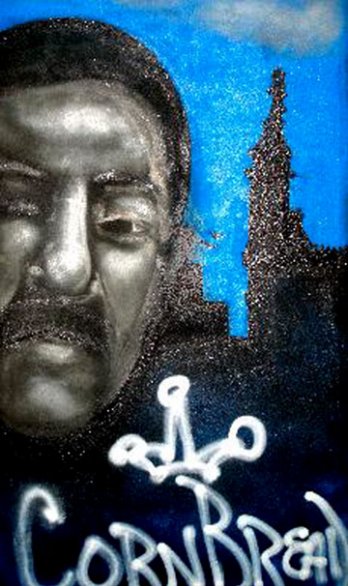
CORNBREAD

Darryl “Cornbread” McCray is a former Philadelphia graffiti artist who gained notoriety for spraying his logo across the city from the late 1960s to early 1970s. Now a mild-mannered arts advocate, McCray is appalled by the evolution of graffiti as an art to a form of vandalism. It was in the 1980s when McCray realized how spray paint and vandalism left Philadelphia a mess. McCray helped clean-up his city by becoming a member of Mayor Wilson Goode’s former Anti-Graffiti Network. Since this time, McCray has become an avid supporter of the Philadelphia Mural Arts Program, and works as a public speaker for this cause.

Jon E. Bekken, chairman of Albright College’s communications department realized McCray’s value as a knowledgeable expert in street art and invited the artist to speak at the school. “I’m interested in a wide range of communications, in particular in ways in which people who don’t have access to media outlets try to get a voice,” Bekken said. McCray gave some pointers to prospective taggers of the college: “If you’ve got the talent to do graffiti, you can get paid for it. But don’t go out and vandalize.”